If you’ve ever typed “indo chinese food near me” into your phone at 7 p.m. on a Friday, you already know the craving — that specific hunger for something bold, saucy, smoky, and deeply satisfying that doesn’t quite fit into one culinary box. In 2026, that search is more common than ever across the Greater Toronto Area, and for good reason. Indo-Chinese cuisine has quietly become one of the most beloved fusion food styles in the GTA, appearing on menus from Mississauga to Scarborough — and right here in Brampton, where our community’s appetite for it keeps growing every single week.
At Dosa Den, we’ve watched this love affair unfold from the front row. Alongside our 40+ varieties of freshly prepared dosas and our deep menu of authentic South Indian favourites, our Indo-Chinese offerings have drawn in curious first-timers and devoted regulars alike. So we wanted to take a moment — not to sell you something, but to actually explain what this cuisine is, where it comes from, and why it hits the way it does.
⚡ QUICK ANSWER
Indo-Chinese food is a unique culinary fusion that blends Indian spices and flavour profiles with Chinese cooking techniques like stir-frying and deep-frying. Originating in the Indian-Chinese communities of Kolkata, it has evolved into a wildly popular street food and restaurant style across India and the South Asian diaspora worldwide — including right here in Brampton. Dishes tend to be punchy, saucy, and built for bold palates.
What Is Indo-Chinese Food, Really?
Indo-Chinese food is a fusion cuisine that combines the bold spice philosophy of Indian cooking with the wok-based techniques and ingredients of Chinese cuisine. It is not traditional Chinese food, nor is it a faithful reproduction of any single regional Indian style — it is something entirely its own, born from cultural exchange and refined over generations.
The story starts in Kolkata (formerly Calcutta), where a small but influential community of Chinese immigrants — many of them Hakka Chinese — settled in the 18th and 19th centuries. They opened restaurants and adapted their cooking to local Indian tastes, swapping out ingredients their neighbours were unfamiliar with and leaning into the aromatics, chilies, and spice levels that Indians loved. The result was a cuisine that felt simultaneously exotic and deeply familiar to Indian diners. Soy sauce met cumin. Spring onions met coriander. Cornstarch-thickened sauces met fiery green chilies.
By the late 20th century, Indo-Chinese dishes had spread far beyond Kolkata, becoming a staple of street food stalls and urban restaurants across India. Today, dishes like chili paneer, Manchurian, gobi Manchurian, hakka noodles, and fried rice are instantly recognisable to virtually any Indian diner — and to the millions of South Asians living in cities like Brampton, Toronto, and beyond.
“Indo-Chinese food isn’t an accident of history — it’s a masterpiece of adaptation. It took the best of two great culinary traditions and built something that belongs entirely to its own people.”
What makes it distinct from, say, a standard Chinese-Canadian takeout menu? The spice level, for one — Indo-Chinese cooking is typically much hotter, with fresh green chilies, red chili sauce, and black pepper playing starring roles. The aromatics are also richer, with ginger-garlic paste doing heavy lifting in nearly every dish. And the sauces tend to cling beautifully to the food rather than pooling at the bottom of the plate.
Why Has Indo-Chinese Cuisine Taken Off So Strongly Across the GTA?
The GTA’s Indo-Chinese food scene is thriving because the city’s large and growing South Asian community has brought its food culture with it — and the rest of the city has followed. The Greater Toronto Area is home to one of the largest South Asian diaspora populations outside of the Indian subcontinent, and with that comes an enormous appetite for the flavours people grew up with.
But it’s not just nostalgia driving the trend. Indo-Chinese food genuinely converts newcomers. It’s the kind of cuisine that doesn’t require any prior cultural context to enjoy — you taste it once, and your palate immediately understands. The umami from soy sauce, the heat from chilies, the satisfying crunch of a well-fried cauliflower floret coated in sticky Manchurian sauce — these are universally appealing textures and flavours.
In Brampton specifically, where the South Asian community is deeply rooted and continues to expand, demand for authentic Indo-Chinese preparations has risen sharply. People aren’t looking for a watered-down approximation — they want the real spice level, the real sauce texture, the real flavour depth they remember from back home or from their parents’ cooking. That’s a standard we take seriously at Dosa Den.
There’s also the vegetarian dimension. Indo-Chinese cuisine, unlike many other fusion styles, has an incredibly rich vegetarian tradition. Gobi Manchurian, paneer chili, veg fried rice, hakka noodles — these aren’t afterthoughts on the menu. They are the menu. For the large vegetarian-leaning South Asian community in Brampton and the wider GTA, that makes Indo-Chinese food a natural fit. You never feel like a second-class diner when you skip the meat — the vegetarian options are the stars of the show.
For more on how authentic South Indian and fusion Indian food fits into the broader dining landscape here, take a look at our deep dive: The Ultimate Guide to South Indian Food in Brampton.
How Does Indo-Chinese Food Actually Taste? What Should You Order First?
Indo-Chinese food tastes like the best version of bold, layered, crave-worthy comfort food — spicy, slightly sweet, deeply savoury, and always satisfying. If you’ve never had it before, the flavour profile will surprise you with how familiar yet completely new it feels.
Let’s break down the flavour logic. The base of most Indo-Chinese dishes relies on a combination of soy sauce (for umami depth and colour), vinegar (for brightness and a mild tang), chili sauce or fresh green chilies (for heat), and a ginger-garlic paste that gives everything a warm, aromatic backbone. Cornstarch is used both as a coating for fried items and as a thickener for sauces, which is why Indo-Chinese gravies have that glossy, lacquer-like quality that coats every bite.
Starter Dishes Worth Trying
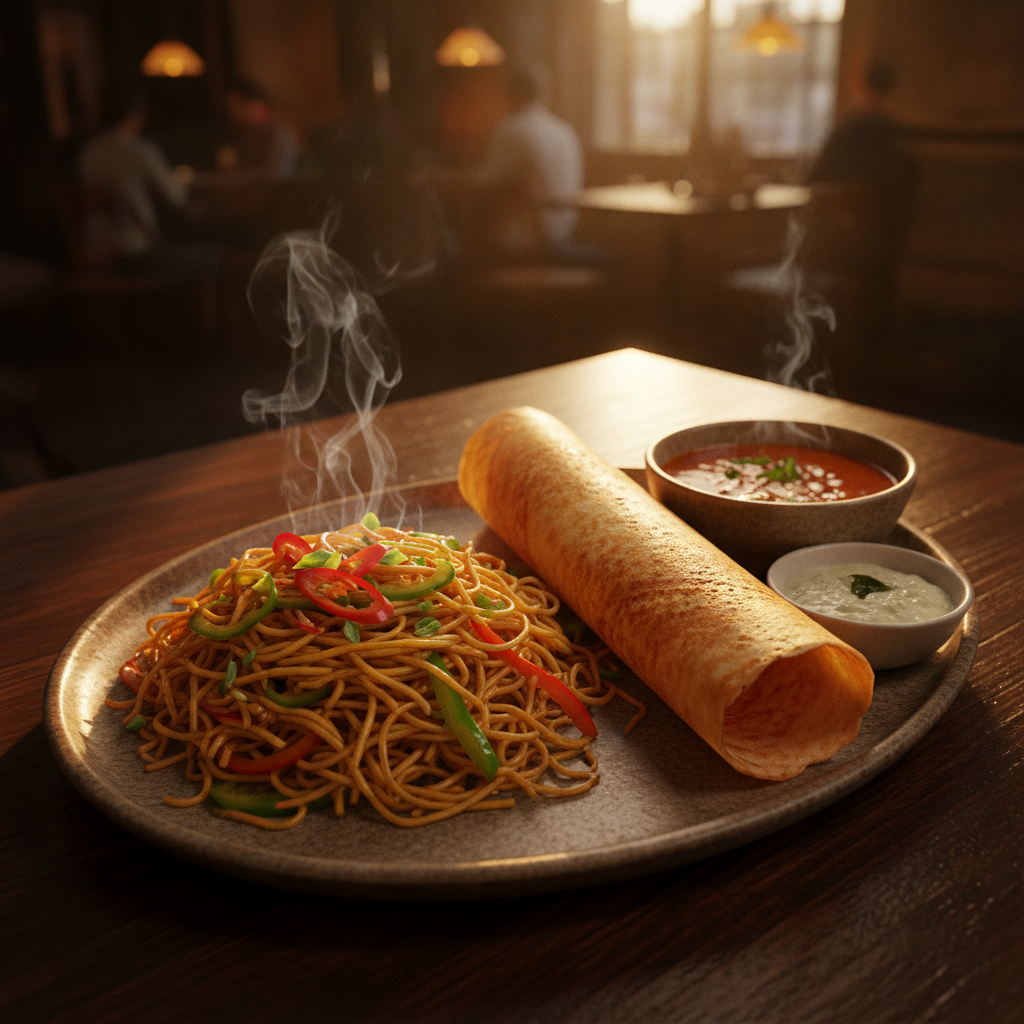
If you’re new to Indo-Chinese cuisine, a few dishes make excellent entry points. Gobi Manchurian — crispy cauliflower florets tossed in a tangy, spicy Manchurian sauce — is perhaps the most iconic dish in the genre. It’s simultaneously light and intensely flavoured, and it converts sceptics almost instantly. Chili paneer is another classic: soft cubes of Indian cottage cheese stir-fried with bell peppers and onions in a bold, fiery sauce. If you want something that works as both a starter and a main, hakka noodles are a crowd-pleaser — springy noodles tossed in a wok with vegetables, soy, and just enough chili to keep you reaching for more.
The Difference Between “Dry” and “Gravy” Preparations
One thing worth knowing before you order: most Indo-Chinese dishes come in two styles — dry and gravy. The dry version means the sauce is reduced and tossed through the dish so every piece is glazed and sticky. The gravy version has more sauce and is better suited to eating alongside rice or bread. Neither is better — it depends entirely on what you’re pairing it with and how you like your food. When you’re dining with us in Brampton, our team is always happy to guide you toward the version that suits your order best.
Where Can You Find the Best Indo-Chinese Food in Brampton?
When people search for the best indo chinese food Brampton has to offer, they’re not just looking for spicy noodles — they’re looking for the full experience: generous portions, authentic flavour, fresh ingredients, and a spot that feels like it genuinely cares about the food it’s putting out. That’s a combination that’s harder to find than it sounds.
At Dosa Den, our Indo-Chinese menu is prepared by expert chefs who bring the same dedication to these dishes as they do to our South Indian classics. We’re not a restaurant that treats fusion food as a side hustle — every dish on our menu, from the crispiest gobi Manchurian to the most perfectly sauced hakka noodles, is made with the same care and genuine flavour philosophy that has earned us over 5,000 happy customers.
We’re located at 10 Gillingham Dr, Unit #104, Floor 1, Brampton, ON L6X 5A5 — right in the heart of a community that takes its food seriously. Whether you’re dining in and soaking up the warm ambiance, calling ahead for takeout, or planning a catered event where you want to wow your guests with something that goes beyond the predictable, our team is ready to make it happen.
For those exploring the broader South Indian dining scene in the region, our guide on Dosa in Mississauga: Your Complete Guide to Finding the Real Thing is a great companion read — because great food doesn’t stop at city limits.
What separates a genuinely great Indo-Chinese plate from a mediocre one? It almost always comes down to the wok technique and the freshness of the sauce. Pre-made sauces that sit around lose their brightness. Dishes that aren’t tossed at high heat lose that characteristic smoky edge — what cooks sometimes call “wok hei.” At Dosa Den, we make our sauces fresh and cook to order, because that’s the only way to deliver the real thing.
How Does Indo-Chinese Food Fit Alongside a Full South Indian Menu?
Indo-Chinese food and South Indian cuisine coexist naturally on a menu because they share a fundamental philosophy: vegetarian ingredients deserve the full spotlight, not just an honourable mention. Both culinary traditions have deep, centuries-long vegetarian roots, and both use spice and aromatics as central — not peripheral — flavour tools.
When a family walks into Dosa Den, what we see happen again and again is this: the kids want gobi Manchurian and fried rice, the parents want a masala dosa and filter coffee, and grandma wants idli with sambar. And everyone is happy. That’s exactly the kind of menu breadth we set out to create — not because it’s commercially smart (though it is), but because it reflects how Indian families actually eat. Variety is not a trend; it’s tradition.
Our menu also includes Indian street food and chaat — think pani puri, bhel puri, and pav bhaji — which creates a natural bridge between the deeply traditional South Indian side of what we do and the more modern, street-food energy of Indo-Chinese cooking. It’s a full ecosystem of flavour, all under one roof in Brampton.
If you’re curious about how South Indian food itself works — the fermentation behind dosa batter, the complexity of sambar, the philosophy of a thali — our article on Top 10 South Indian Vegetarian Dishes to Try at a GTA Restaurant is a great place to start.
The point is this: searching for “dosa near me” or “dosa brampton” might be what brings you to us initially — but once you’re here and you see the full menu, most people realise they’ve found something bigger than just a dosa restaurant. They’ve found a place where the entire spectrum of Indian vegetarian cooking is done right.
Ready to Try Indo-Chinese Done Right in Brampton?
Whether you’re craving gobi Manchurian, hakka noodles, chili paneer, or you want to explore our full menu of 100+ dishes — we’re here for you. Dine in, order takeout, or let us cater your next event. Over 5,000 happy customers can’t be wrong.
Visit Dosa Den → Explore Our Full Menu
📍 10 Gillingham Dr, Unit #104, Floor 1, Brampton, ON L6X 5A5
✍️ Written by the Dosa Den Team — We’re a passionate crew of food lovers, chefs, and community builders based right here in Brampton. Our mission is simple: to bring the full, honest flavour of Indian vegetarian cuisine — from crispy dosas to smoky Indo-Chinese stir-fries — to every table we serve.
Frequently Asked Questions
What is Indo-Chinese food and how is it different from regular Chinese food?
Indo-Chinese food is a fusion cuisine that originated in the Hakka Chinese communities of Kolkata, India, blending Chinese cooking techniques like stir-frying with Indian spices, aromatics, and chili heat. Unlike traditional Chinese cuisine, Indo-Chinese food is significantly spicier, uses ginger-garlic paste as a core flavour base, and leans heavily on dishes that appeal to Indian vegetarian palates — like gobi Manchurian, chili paneer, and hakka noodles. It is its own distinct culinary tradition, not a variation of either parent cuisine.
How spicy is Indo-Chinese food — can my whole family enjoy it?
Indo-Chinese food can range from mildly spiced to very fiery depending on the dish and how it’s prepared. Many dishes can be adjusted to suit different heat preferences, making it genuinely family-friendly when you communicate your comfort level. At Dosa Den in Brampton, our team is always happy to tailor dishes to suit younger diners or those who prefer a gentler spice level without sacrificing the core flavours that make Indo-Chinese cuisine so special.
Why do so many Indian restaurants in the GTA include Indo-Chinese items on their menu?
Indo-Chinese food has been a staple of Indian urban dining for decades, so for many GTA residents — especially those from South Asian backgrounds — it is simply part of what “going out for Indian food” means. It’s not a trend; it’s a deeply embedded part of Indian food culture. Restaurants that serve South Asian communities understand that diners expect this range, and offering it authentically is a mark of respect for the full breadth of what Indian cuisine actually looks like.
Can I order Indo-Chinese food from Dosa Den for a party or catered event?
Absolutely — catering and party event services are one of our most popular offerings at Dosa Den. Indo-Chinese dishes like Manchurian, fried rice, and chili paneer travel and scale beautifully, making them crowd favourites for large gatherings. You can pair them with South Indian items and street food for a full spread that covers every taste at the table. Reach out to our team in Brampton to discuss a custom catering menu for your next event.