If you have ever typed “indian restaurant toronto” into your phone while craving something warm, fermented, and deeply satisfying, there is a good chance that idli — that soft, pillowy, steamed rice cake — was somewhere in the back of your mind. It is one of those dishes that sounds simple but carries the kind of complexity that only comes from generations of practice, patient fermentation, and an understanding of what comfort food is really supposed to feel like. In 2026, as South Indian cuisine continues to earn its well-deserved spotlight across the Greater Toronto Area, idli remains the quiet hero of every authentic South Indian menu — understated, nourishing, and absolutely impossible to replicate on a bad day.
At Dosa Den, we have served thousands of guests in Brampton who walk through our doors asking about our dosas and leave completely converted to idli as well. It happens more often than you might think. Someone arrives for the first time, scans the menu, spots idli listed with sambar and coconut chutney, and decides to give it a chance out of curiosity. Twenty minutes later, they are planning their next visit. That is the quiet magic of this dish. And in this guide, we want to share everything we know about getting it right — whether you are attempting it at home or searching for the real thing close by.
⚡ QUICK ANSWER
Perfect idli depends on three things: the right ratio of urad dal to rice, a proper fermentation window of 8–12 hours, and gentle steaming. If you would rather skip the kitchen entirely, Dosa Den in Brampton serves freshly prepared idli with authentic sambar and coconut chutney as part of a 100+ item South Indian vegetarian menu — dine in or take out.
What Exactly Is Idli and Why Does It Matter So Much?
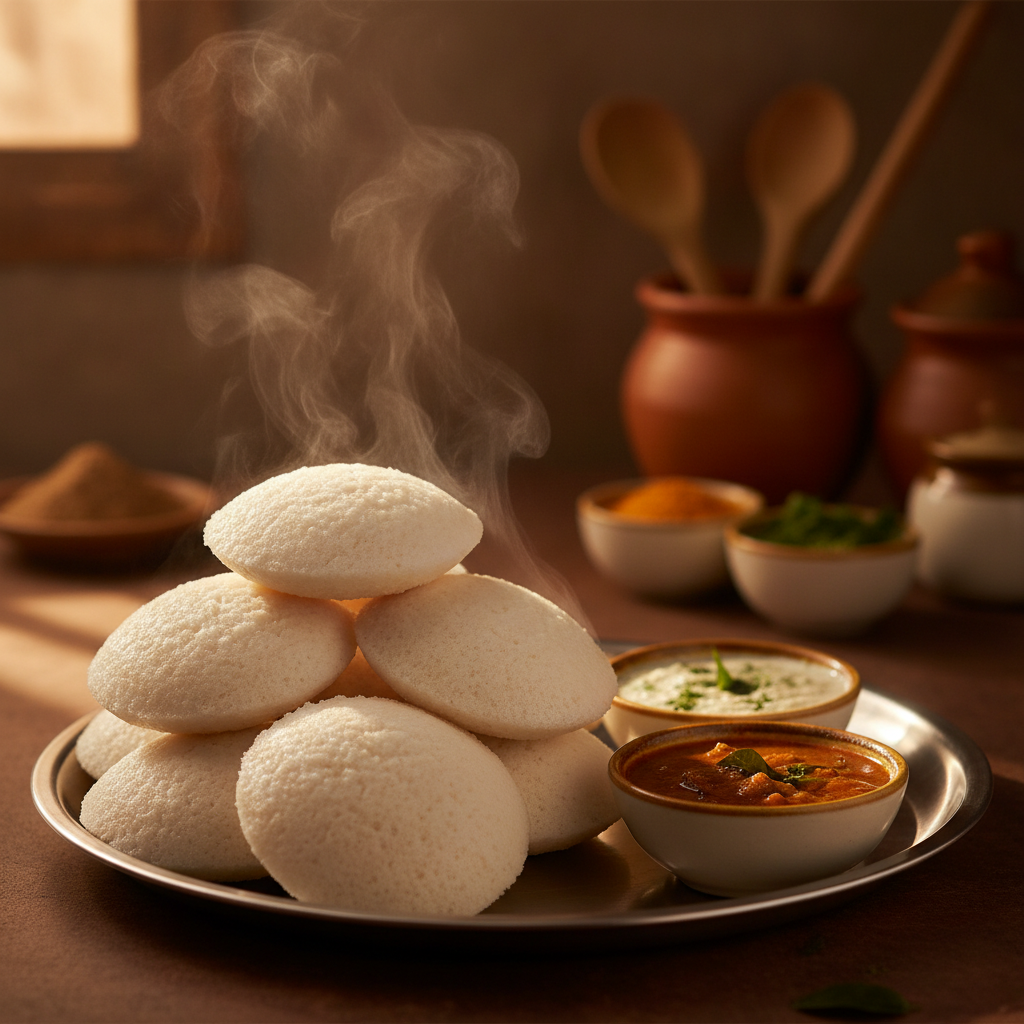
Idli is a steamed South Indian rice cake made from a fermented batter of rice and urad dal (split black lentils), and it is one of the oldest, most nutritionally sound breakfast foods in the culinary world. The fermentation process is not just a technique — it is a transformation. Overnight, the batter becomes airy, slightly tangy, and rich with natural probiotics that make idli both easy to digest and genuinely nourishing.
Its roots stretch back more than a thousand years through Tamil Nadu, Karnataka, Kerala, and Andhra Pradesh — regions where idli is not considered a specialty but an everyday staple. Served alongside a bowl of hot sambar (a lentil-based vegetable stew) and fresh coconut chutney, a plate of idli is what mornings are made of in South India. It is filling without being heavy, flavourful without being loud, and satisfying in a way that lingers.
Here in Brampton, South Indian food has found a genuinely enthusiastic audience. Families who grew up eating idli every morning, students rediscovering their roots, and curious food lovers who stumbled onto south indian food near me on a whim — all of them end up at the same place. And when the idli is right, you know it immediately. It tears cleanly, it is soft without being wet, and it carries the gentle tang of fermentation in every bite.
“Idli is proof that the most profound flavours do not require complexity — they require patience, the right ingredients, and respect for a process that has been perfected over centuries.”
Understanding what makes idli special is the first step. The second step is understanding why getting it wrong is so easy — and how to avoid the most common mistakes, whether you are cooking at home or choosing where to eat.
How Do You Make Idli Right the First Time?
Making great idli at home comes down to mastering four core elements: ingredient quality, batter ratio, fermentation time, and steaming technique. Get all four right and your first batch will surprise you. Miss even one and you will end up with dense, flat, or sour cakes that bear little resemblance to what you were hoping for.
The Right Ratio
The most widely trusted ratio for idli batter is 4 parts idli rice (parboiled rice) to 1 part urad dal. This is not a rule to experiment with on your first attempt. The rice provides structure and the mild, slightly starchy base. The urad dal, once soaked and ground, becomes a thick, airy foam that gives idli its characteristic softness and lift. Using regular long-grain rice instead of parboiled idli rice, or skipping the dal soaking step, are the two most common first-timer mistakes.
Soak the rice and dal separately for at least four hours — some experienced cooks prefer six. Grind the dal first until it is smooth, light, and almost mousse-like in texture. Then grind the rice to a slightly coarser consistency. Combine them gently. The batter at this point should be thick but pourable, similar to a loose pancake batter.
The Fermentation Window
Fermentation is where most home cooks run into trouble, especially in colder climates like ours here in the Greater Toronto Area. In South India, leaving batter on the counter overnight is usually enough. In Brampton, particularly from October through March, your kitchen may simply be too cold for natural fermentation to take hold reliably. The solution is to use your oven with just the light turned on, which creates a gentle warmth of around 26–30°C — ideal fermentation territory. Leave the batter for 8 to 12 hours. When it has doubled in volume and smells pleasantly sour, it is ready. If it smells sharp or acidic, it has gone too long.
The Steaming Process
Grease your idli moulds with a neutral oil — coconut oil is traditional and adds a subtle warmth to the flavour. Fill each mould about three-quarters full. Steam on medium-high heat for exactly 10 to 12 minutes. Do not open the lid during steaming. Do not over-fill the moulds. And critically, do not over-steam — idli that stays on the heat too long becomes rubbery and dry. Insert a clean skewer or toothpick to test; if it comes out clean, they are done. Let them rest for two minutes before gently sliding them out with a spoon.
The Sambar and Chutney Are Not Optional
A plate of idli served without sambar and coconut chutney is technically correct but culinarily incomplete. Sambar — a tamarind-laced, toor dal-based stew loaded with vegetables and tempered spices — provides the liquid warmth that idli soaks up beautifully. Coconut chutney, ground fresh with green chilli, ginger, and mustard seeds, adds brightness and a cooling contrast. Together, these three components are a system, not just a meal.
For anyone who wants to explore Top 10 South Indian Vegetarian Dishes to Try at a GTA Restaurant, idli with sambar almost always appears on that list — and for good reason.
Why Is Homemade Idli So Hard to Get Consistently Right?
The honest answer is that idli is sensitive to variables that home kitchens cannot fully control. Restaurant-quality idli is consistent because every element — batter preparation, fermentation environment, steaming equipment, and even water quality — is standardized. At home, those variables shift constantly.
The water you use matters more than most people realize. Heavily chlorinated tap water can inhibit the natural fermentation process, which relies on wild yeasts and lactic acid bacteria already present in the ingredients. Many serious home cooks use filtered water for their batter specifically for this reason. Seasonal temperature swings in the GTA mean that summer batches ferment faster than winter ones, sometimes by several hours, which requires constant adjustment.
The grinder also plays a role. A wet grinder — the traditional stone tool used in South Indian kitchens — produces a finer, more aerated batter than a blender. If you only have a high-speed blender, use it in short bursts, keep the batter cold, and accept that the texture will be slightly different. It will still be good. It just will not be identical to what you get from a stone-ground batter.
This is not meant to discourage you from trying — quite the opposite. Every attempt teaches you something. But it does explain why, on those evenings when you simply need idli and you need it to be right, there is a compelling case for finding a trusted spot nearby. Searching for idli near me in Brampton leads many people straight to us, and we are genuinely glad it does.
For a broader look at what the South Indian food landscape looks like across the region, our friends who love exploring the city often reference The Ultimate Guide to South Indian Food in Brampton as a great starting point.
Where Can You Find Authentic Idli Near You in Brampton?
If you are searching for south indian food near me or specifically hunting down idli near me in the Brampton and Greater Toronto Area, the key is knowing what to look for — and knowing what separates a restaurant that does idli well from one that treats it as an afterthought.
At Dosa Den, idli is made fresh daily from properly fermented batter. Our sambar is prepared with a blend of vegetables and tamarind that balances richness with brightness, and our coconut chutney is ground to the right consistency — not too thin, not paste-thick. These are not details we advertise loudly. They are simply part of how we work, because our team grew up with these flavours and we know what the standard is supposed to be.
Located at 10 Gillingham Dr, Unit 104, Brampton, ON L6X 5A5, we are centrally situated to serve families and individuals from across Brampton and the wider GTA. Whether you are looking for a sit-down meal, or you need takeout indian food near me on a Tuesday evening when cooking feels like the last thing you want to do, we are ready. Our takeout service makes it easy to bring a full South Indian spread home — idli, sambar, chutney, and as many varieties of dosa as you want on the side.
We have been lucky to build a community of over 5,000 happy customers since opening, and if there is one thing they tell us consistently, it is that Dosa Den feels like the South Indian restaurant they were always looking for but never quite found. Warm, unpretentious, and genuine in every plate.
If you are curious about how Brampton’s South Indian dining scene compares to neighbouring areas, we also have a full resource on Dosa in Mississauga: Your Complete Guide to Finding the Real Thing — because finding good regional food should never feel like a guessing game.
What Else Should You Try Alongside Idli at Dosa Den?
Idli is a wonderful starting point, but at Dosa Den it is just one corner of a much larger menu. We offer 40+ varieties of freshly prepared dosa — from the classic masala dosa and the buttery benne dosa to more adventurous varieties — along with a full range of South Indian breakfast dishes, chaats, street food, and Indo-Chinese options that keep our regulars returning week after week.
For those searching dosa brampton or dosa near me, we are the destination that consistently comes up — and not just because of our location, but because of the quality that our chefs bring to every order. Every dosa is made to order, golden and crisp on the outside, perfectly seasoned on the inside, and served hot.
Beyond dosa and idli, our menu extends into Indian street food — pani puri, bhel puri, pav bhaji — and a full Indo-Chinese section that bridges two beloved cuisines in a way that the GTA has genuinely embraced. If you are bringing a group with varied tastes, there is something for everyone on our 100+ item menu, all of it vegetarian, all of it freshly prepared.
We also offer catering and party event services for families and groups who want to bring authentic South Indian food to their celebrations. If you are planning an event in Brampton or the surrounding GTA and want a spread that will genuinely impress, reach out to our team and we will work with you to build a menu that fits.
For anyone discovering South Indian cuisine for the first time and wondering what sets it apart from other regional Indian cuisines, our detailed guide on Best Indian Restaurants in Brampton: What Sets South Indian Cuisine Apart is a great read before your first visit.
Ready for Idli That Actually Gets It Right?
Come visit us at Dosa Den in Brampton — freshly made idli, 40+ dosa varieties, and a full South Indian vegetarian menu waiting for you. Dine in, take out, or plan a catered event. Over 5,000 happy customers have already found their favourite table. Yours is waiting.
📍 10 Gillingham Dr, Unit #104, Brampton, ON L6X 5A5
✍️ Written by the Dosa Den Team
We are the chefs, hosts, and food lovers behind Dosa Den in Brampton — a South Indian restaurant built around 100+ authentic vegetarian dishes, 40+ freshly made dosas, and a genuine love for the cuisine we grew up with. When we are not in the kitchen, we are writing about the food we care most about, so you always know what to expect when you walk through our doors.
Frequently Asked Questions
How long does idli batter need to ferment?
Idli batter needs to ferment for 8 to 12 hours in a warm environment. In a cold climate like Brampton’s winters, place the batter in an oven with just the light on to maintain the gentle warmth of around 26–30°C that fermentation requires. The batter is ready when it has visibly risen and smells pleasantly sour — not sharply acidic.
What makes restaurant idli taste different from homemade?
Restaurant idli — especially at a dedicated South Indian restaurant — benefits from stone-ground batter, controlled fermentation environments, and professional steaming equipment that maintains consistent heat. At Dosa Den, we prepare our batter fresh daily and steam every order to order, which is why the texture is reliably soft without being wet or dense. At home, variables like water quality, grinder type, and ambient temperature all affect the result in ways that are hard to standardize.
Why is sambar served with idli?
Sambar and idli are paired together because they function as a culinary system — idli’s neutral, slightly tangy base absorbs the rich, tamarind-laced depth of sambar beautifully. The combination also balances nutrition: the lentils and vegetables in sambar complement the fermented rice and urad dal protein in idli. Coconut chutney completes the trio with brightness and cooling contrast. Together, the three components create a meal that is satisfying, complete, and deeply traditional.
Can I order idli for takeout at Dosa Den in Brampton?
Yes, absolutely. Dosa Den offers full takeout service, and idli with sambar and chutney travels well when packed properly. Whether you are searching for takeout indian food near me after a long day or planning a South Indian breakfast spread for family at home, our team will have your order ready fresh. Visit us at 10 Gillingham Dr, Unit 104, Brampton, or check our full menu and ordering options at Dosa Den.