If you’ve ever typed “pav bhaji near me” into your phone at 6 p.m. on a weeknight — hungry, tired, and craving something warm and deeply satisfying — you already understand the magnetic pull of this dish. In 2026, pav bhaji has moved well beyond its Mumbai origins to become one of the most searched and most loved vegetarian street foods across the GTA, and for good reason: it is filling, flavourful, and almost impossible to eat without smiling.
At Dosa Den in Brampton, we serve pav bhaji as part of a broader street food menu that also includes chaat, South Indian classics, and Indo-Chinese specialties — all freshly prepared, all vegetarian, and all made with the kind of care that keeps families, students, and working professionals coming back week after week. But before we talk about what’s on the plate in front of you, let’s talk about where this dish came from and why it deserves a permanent spot on your must-try list.
⚡ QUICK ANSWER
Pav bhaji is a popular Indian street food dish made from a spiced, buttery mash of vegetables (the bhaji) served alongside soft, toasted bread rolls (the pav). It originated in Mumbai and is entirely vegetarian. At Dosa Den in Brampton, it is served freshly made as part of our Indian street food and chaat menu — making it one of the most satisfying vegetarian meals you can find in the GTA.
What Exactly Is Pav Bhaji — and Where Did It Come From?
Pav bhaji is a two-part street food dish: pav refers to soft, pillowy bread rolls toasted on a flat griddle with butter, and bhaji is a thick, vibrantly spiced vegetable mash. Together, they create a combination that is simultaneously humble and extraordinary — the kind of food that feels like a warm hug after a long day.
The dish was born on the streets of Mumbai, India’s chaotic, beautiful, always-hungry financial capital. The story goes that mill workers in the textile districts of South Mumbai needed a quick, hot, affordable meal during their short lunch breaks. Street vendors began mashing together leftover vegetables — potatoes, cauliflower, peas, tomatoes, capsicum — seasoning them aggressively with a signature spice blend now known as pav bhaji masala, and serving the whole thing with buttered bread rolls. It was fast, cheap, and extraordinarily delicious. Mumbai adopted it completely, and the rest of India followed.
Today, pav bhaji is considered one of India’s great street food contributions — right alongside vada pav, chaat, and sev puri. If you want to understand the full landscape of Indian street food, you’d do well to start with pav bhaji and work outward from there. Our friends at What Is Chaat? Your Guide to India’s Most Exciting Street Food have covered a lot of that territory too — and it pairs beautifully with everything you’re about to learn here.
How Is Pav Bhaji Made? A Look at the Real Technique
Great pav bhaji is built on three non-negotiable pillars: fresh vegetables, proper spicing, and generous butter. Skip any one of them and the dish becomes ordinary. Master all three and you have something unforgettable.
The Bhaji: Building the Mash
The vegetable base typically includes boiled potatoes, green peas, tomatoes, onions, capsicum (green bell pepper), and often cauliflower or carrots. These are cooked down on a large, flat iron griddle — called a tawa — until they are completely soft. The cook then mashes everything together directly on the hot surface, incorporating the cooking juices and aromatics as they go.
The spice blend is critical. Pav bhaji masala — a pre-blended mix of coriander, cumin, dried chillies, amchur (dry mango powder), and other aromatics — is added in generous quantities. Red chilli powder, turmeric, and ginger-garlic paste build additional depth. Butter (a lot of it) is worked in throughout the process, giving the bhaji its characteristic richness and slight sheen.
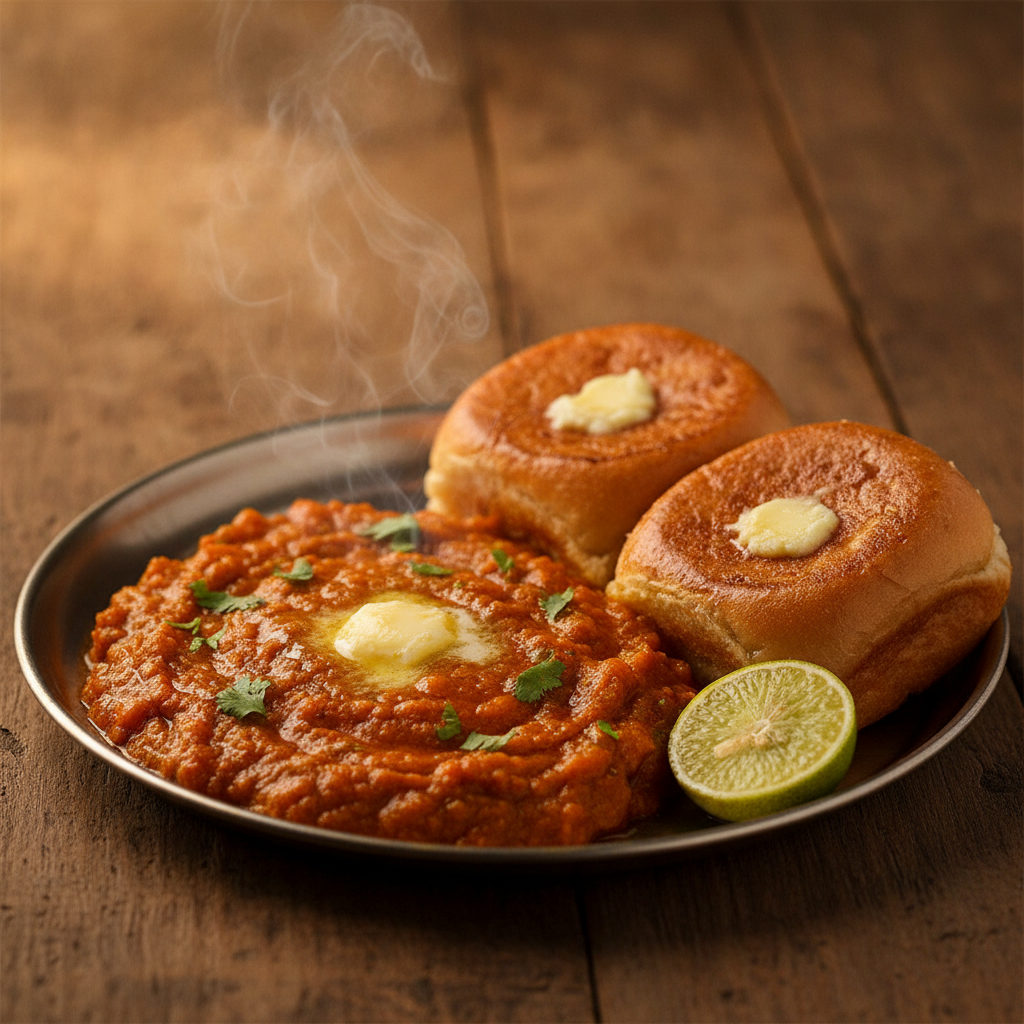
The final bhaji should be thick enough to mound on a plate, deeply orange-red in colour, and fragrant enough to draw people across a room. It is garnished with finely chopped raw onion, fresh coriander, a squeeze of lime, and often a small pat of extra butter melting on top.
The Pav: Getting the Bread Right
The bread rolls used for pav bhaji are soft, slightly sweet, and quite different from a dinner roll or a bun. They are sliced horizontally and toasted face-down on the same buttered tawa, often with a pinch of pav bhaji masala rubbed into the butter for extra flavour. The goal is a bread that is golden and slightly crispy on the cut side, completely soft everywhere else, and absolutely saturated with butter. The pav is not a vehicle for the bhaji — it is an equal partner.
The Assembly: Simple and Intentional
A generous portion of bhaji goes onto the plate, topped with butter, chopped onion, coriander, and a wedge of lime. The toasted pav rolls are placed alongside. You tear a piece of pav, drag it through the bhaji, and eat. That’s the whole ritual — and it is completely, perfectly satisfying every single time.
“A great pav bhaji is not assembled — it is built. Every layer of flavour on that tawa tells a story, and by the time it reaches your plate, you can taste the whole journey.”
Why Does Pav Bhaji Belong on Every Vegetarian’s Must-Try List?
Pav bhaji belongs on every vegetarian’s must-try list because it proves, definitively and deliciously, that plant-based cooking can be bold, satisfying, and deeply craveable without compromise. This is not a side dish or a light snack — it is a full, hearty meal that leaves you genuinely full and genuinely happy.
For families dining out in Brampton, pav bhaji offers universal appeal. Kids love the soft bread and the mild-but-flavourful mash. Adults appreciate the complexity and the comfort. Students looking for veg food near me that won’t break a budget find it hits every mark — filling, affordable, and genuinely tasty. Working professionals who want a quick, satisfying lunch or dinner that doesn’t feel like a compromise will find pav bhaji delivers every time.
There is also something culturally important about this dish. Pav bhaji is the kind of food that carries memory. For many South Asian families across the GTA, it connects to childhood evenings at Juhu Beach in Mumbai, to street stalls outside college campuses, to Sunday afternoons in a grandmother’s kitchen. Eating it at a restaurant that makes it properly — with fresh vegetables, real spicing, and the right amount of butter — is a genuinely meaningful experience, not just a meal.
And for those who are discovering Indian street food for the first time, pav bhaji is an ideal entry point. It is approachable without being bland. It is flavourful without being intimidating. It introduces you to the logic of Indian spicing — the layering, the balance of heat and acidity, the role of fresh herbs and aromatics — in a context that feels immediately welcoming. If you’re curious about how pav bhaji fits within the broader world of Indian street food, our guide to Your Top Questions About Chaat, Answered is a great companion read.
How Does Pav Bhaji Fit Into a South Indian Restaurant Menu?
Pav bhaji fits naturally into a South Indian restaurant menu because it represents the same values that define great South Indian cooking: fresh ingredients, bold spicing, and deeply satisfying vegetarian food made with skill and care.
It’s worth clarifying something that confuses a lot of first-time visitors: pav bhaji is technically a Mumbai dish — which makes it North Indian in origin, not South Indian. So why does a South Indian restaurant in Brampton serve it? Because the best South Indian restaurants in the GTA have always understood that their customers want more than just one regional cuisine. They want a full Indian vegetarian dining experience.
At Dosa Den, our menu reflects that reality. We serve 40+ varieties of freshly made dosa — the crispy, fermented rice crepe that is the crown jewel of South Indian cooking — alongside a full menu of Indian street food and chaat that includes pav bhaji, bhel puri, sev puri, and more. We also offer Indo-Chinese specialties that have become a GTA favourite in their own right. Over 100 menu items across multiple culinary traditions, all vegetarian, all freshly prepared.
The reason this works is simple: the underlying philosophy is consistent. Whether we are making a paper-thin ghee roast dosa or a rich, buttery pav bhaji, we are applying the same commitment to fresh ingredients, proper technique, and authentic flavour. The geography of the recipes differs; the standard of cooking does not.
For GTA diners who search for indian street food near me or indian breakfast near me, a well-rounded South Indian restaurant that also does justice to Mumbai street food staples like pav bhaji is genuinely valuable — because it means you don’t have to drive to three different places to eat well. And if you’ve ever searched for south indian restaurants near me or the best dosa in Brampton and wanted more than just dosa on the menu, you’ll understand exactly why our approach resonates with so many Brampton families and GTA diners.
You can also explore how this variety connects to the broader search for great vegetarian dining in our article on Indian Food in Toronto: How to Find Authentic Vegetarian Options in a Sea of Choices — it covers the landscape of vegetarian Indian dining across the region in a way that’s genuinely useful for anyone navigating their options.
Where to Enjoy Pav Bhaji and Indian Street Food in Brampton
The best place to enjoy pav bhaji and Indian street food in Brampton is at a restaurant where it is made fresh to order, spiced properly, and served with the full set of accompaniments — not reheated, not rushed, and not generic.
Brampton has a thriving South Asian food community, and the GTA more broadly has no shortage of places claiming to serve great Indian food. But freshness and authenticity are not guaranteed everywhere — and when it comes to a dish like pav bhaji, the difference between a properly made version and a mediocre one is enormous. The bhaji should be freshly cooked and mashed on a hot tawa, not scooped from a pot that has been sitting. The pav should be toasted to order with real butter. The garnishes should be crisp and bright.
At Dosa Den in Brampton, we take all of that seriously. Our chefs are skilled and experienced, trained in traditional recipes and committed to the kind of quality that has earned us 5,000+ happy customers and strong verified Google reviews. We have indoor and outdoor seating, making us a great option for families who want to sit down and enjoy a meal together, and we also offer takeout and catering for those who need food for events or on the go.
Whether you are a long-time fan of Mumbai street food, a student exploring Indian cuisine for the first time, or a family looking for a reliable, affordable, and genuinely satisfying dinner in Brampton — pav bhaji at Dosa Den is the kind of meal that earns a return visit. And when you pair it with a masala dosa or a plate of chaat, you have the makings of a genuinely great evening out.
If you’ve been exploring vada pav and want to understand how it compares to pav bhaji within the broader Mumbai street food family, our article on Vada Pav in the GTA: What It Is and Where to Find It is worth a read — it’s another dish we love and serve with the same level of care.
Ready to Try Pav Bhaji in Brampton?
Come visit us at Dosa Den — Brampton’s home for freshly made pav bhaji, 40+ dosa varieties, Indian street food, chaat, and Indo-Chinese specialties. Over 5,000 happy customers can’t be wrong. Dine in, take out, or let us cater your next event.
✍️ Written by the Dosa Den Team — We are the team behind Dosa Den, Brampton’s South Indian restaurant serving 40+ dosa varieties and a full menu of Indian street food, chaat, and Indo-Chinese specialties. We write from the kitchen, the dining room, and years of sharing food we genuinely love with the GTA community.
Frequently Asked Questions
What is the difference between pav bhaji and vada pav?
Both are Mumbai street food classics, but they are quite different. Pav bhaji features a spiced, buttery vegetable mash served with toasted bread rolls and generous garnishes — it’s a full, saucy meal eaten with your hands or a spoon. Vada pav is simpler and more portable: a spiced potato fritter (the vada) tucked inside a bread roll with chutneys. Pav bhaji is richer and more substantial; vada pav is a quick, fiery snack. Both are entirely vegetarian and completely delicious.
How spicy is pav bhaji, and can it be adjusted?
Traditional pav bhaji has a moderate level of heat — it is warm and well-spiced rather than fiery. The spice comes primarily from pav bhaji masala, red chilli powder, and ginger, all of which contribute complexity alongside heat. At Dosa Den in Brampton, our team prepares pav bhaji to a balanced level that works for most diners, including families with children. If you have a specific preference, we encourage you to let our team know when you order.
Why is butter so important in a good pav bhaji?
Butter is not a garnish in pav bhaji — it is a structural ingredient. It is incorporated into the bhaji during cooking, used to toast the pav, and added again as a finishing touch on the plate. The fat carries and amplifies the spice flavours, adds richness that makes the bhaji feel satisfying and complete, and gives the dish its characteristic glossy texture. A pav bhaji made with too little butter is noticeably flatter in flavour. Authenticity here means generosity.
Can I order pav bhaji for catering or large group events in Brampton?
Yes — Dosa Den in Brampton offers catering services that include our Indian street food menu alongside our South Indian and Indo-Chinese specialties. Pav bhaji is an excellent choice for group events because it is crowd-pleasing, entirely vegetarian, easy to portion generously, and universally beloved across age groups. Whether you’re planning a family celebration, a corporate lunch, or a community event in the GTA, our catering team can help you put together a menu that works. Reach out through our website to discuss your needs.